CALLVIO

Conversational commerce is the use of messaging or live dialogue to help shoppers discover products, ask questions and complete purchase-related steps. For Pakistani retailers, that might be an Instagram size enquiry, a WhatsApp COD question or a website chat that checks availability before sending a checkout link. It works only when product, inventory, delivery and order information are accurate.
Conversational commerce, explained
Conversational commerce uses messaging apps, website chat, live staff and, where appropriate, AI assistants to support shopping through back-and-forth communication. Shopify describes it as the intersection of messaging, commerce and technologies such as chatbots or voice assistants. It is different from a static FAQ because the conversation can adapt to a shopper's question and, when properly integrated, consult business information.
It does not mean that a purchase must occur completely inside WhatsApp or Instagram. A conversation may lead to a secure Shopify checkout, a human sales representative or an order request that staff must verify.
Why it matters to Pakistani retailers
Many merchants sell through a combination of websites and social channels. A customer may discover an item in a video, ask for measurements on Instagram, request delivery details on WhatsApp and place an order later. The opportunity is to reduce repeated explanations and uncertainty between those steps—not to assume that every chat will become an order.
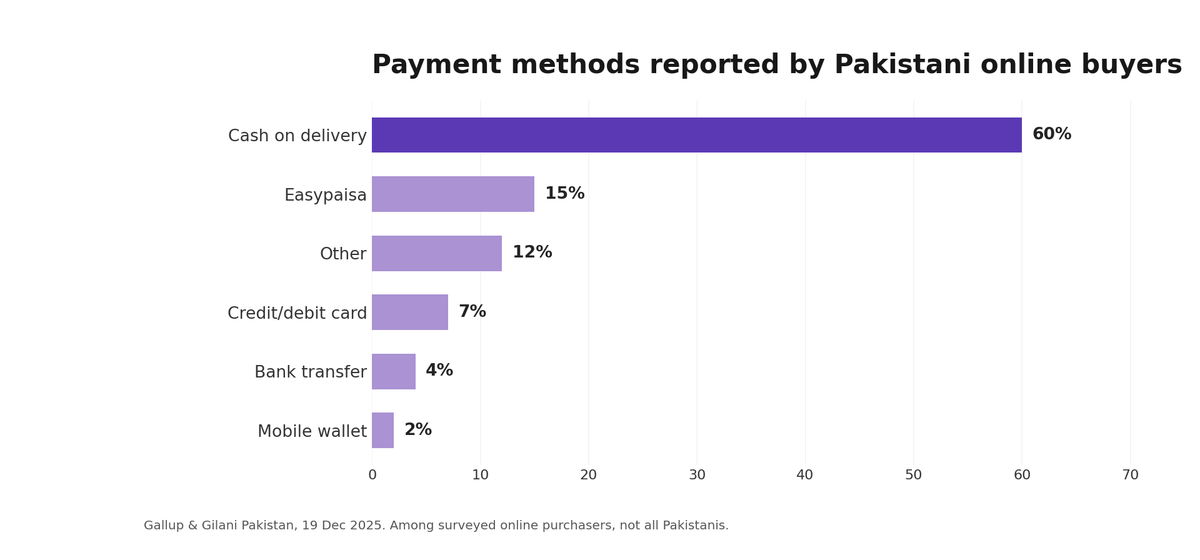
Pakistan-specific purchasing behavior also matters. In a Gallup & Gilani Pakistan poll released on December 19, 2025, 60% of respondents who had bought something online in the preceding six months said they paid cash on delivery; 15% reported Easypaisa and 7% a credit or debit card. These figures describe the surveyed online purchasers—not the whole population, every retailer, or every Shopify transaction. For conversational commerce, they make accurate COD policies and delivery explanations important subjects to address.
Cart friction is substantial globally. Baymard Institute's aggregated research indicates roughly 70% cart abandonment across the studies it tracks. That is not a Pakistan-specific rate. It shows why businesses should resolve uncertainty about shipping fees, checkout complexity and trust before spending heavily on follow-up messages.
Five practical conversational-commerce experiences
1. Product discovery on Instagram
A shopper asks whether a dress is available in a particular size. A connected assistant can use current catalog data to give an accurate answer, share a product link, or ask staff to verify stock. Instagram messaging requires an eligible professional account and the applicable API permissions; it is not unlimited unsolicited outreach.
2. WhatsApp help before checkout
A buyer asks if a store delivers to Multan, what the shipping charge will be and whether cash on delivery is available. The assistant should consult the store's own shipping and payment rules. If the rules do not cover the address, a person should confirm rather than the system guessing.
3. Guided product selection on a website
A visitor compares two products and states a budget. A website assistant can narrow suitable options using genuine specifications, availability and price. A product recommendation must be grounded in actual catalog records, not invented benefits.
4. Order-status questions after purchase
A customer asks whether an order has been dispatched. An integrated service can verify the order through an authorized lookup and return the actual status, or open a support request. Sensitive information should not be disclosed until the customer is appropriately verified.
5. A human-assisted escalation
A customer wants to change a confirmed order, dispute a payment or discuss an exception to the return policy. The AI should capture context and transfer the case; it should not pretend a refund or amendment is complete without confirmation from the relevant system.
What a simple commerce conversation looks like
- Customer: 'Do you have the navy shirt in large?'
- Assistant: checks the authorized catalog and gives the current result; if the record is unavailable, it states that staff will verify.
- Customer: 'How long will delivery to Lahore take?'
- Assistant: quotes the approved delivery estimate and relevant conditions.
- Customer: 'Can I pay COD?'
- Assistant: explains the store's current COD eligibility and provides a secure checkout link or human follow-up.
This is an illustrative workflow, not a transcript or evidence of a specific Callvio deployment.
What needs to be connected
A useful setup usually needs accurate product information, stock, published policies, permitted messaging accounts, a way to create or look up orders and a clear handoff to staff. For Shopify merchants, some WhatsApp marketing and abandonment automations are already supported natively through Shopify Messaging. A third-party conversational layer is most useful when two-way questions, integrated operations or multiple channels need coordination.
How to measure results without exaggerated ROI claims
Review qualified shopping enquiries, time to first meaningful answer, product-link click-throughs, completed orders, order-value contribution, repeat-contact rate, human handoff outcomes and opt-outs. For conversion measurement, compare similar customers with and without the intervention where possible. Gross message counts or purchases following a chat are not proof of incremental revenue.
Getting started: a controlled pilot
- Identify the 20 most common pre-purchase questions from existing customer chats.
- Connect a reliable product catalog and the latest shipping, payment and return policies.
- Choose one channel and a narrow set of permitted actions before expanding.
- Test Urdu, English and Roman Urdu examples against real products and edge cases.
- Track resolution quality, conversions, errors, opt-outs and staff workload.
Where Callvio can help
Callvio's AI communication platform can be configured to answer grounded questions and route enquiries through supported channels such as WhatsApp, Instagram, Facebook and website chat. Shopify and back-office connections should be checked case by case. The target outcome is a better buying journey with appropriate human oversight, not automation for its own sake.
For implementation detail, see Shopify WhatsApp automation in Pakistan for COD and recovery workflows, and managing WhatsApp, Instagram, Facebook and website chats in one inbox for routing and human handoffs.
A conversion is more than a helpful chat reply
A retailer may answer a sizing question correctly but still lose the sale if stock data is stale or the checkout link is broken. Test the full customer journey: product availability, recommended size using approved data, COD eligibility, checkout completion and post-order status. Measure confirmed orders and customer satisfaction separately from response speed.
Connect channel enquiries with a WhatsApp, Instagram and website inbox and follow the Shopify automation guide for order-linked actions.
How does conversational commerce work for a Pakistani online clothing store?
A shopper asks on Instagram whether a particular shirt is available in a size. The assistant checks an approved catalogue or live inventory, explains the delivery terms and offers the appropriate product or checkout link. If the shopper moves to WhatsApp, the system should request an order or contact identifier before linking private order information.
When the shopper places a COD order, a separate verification workflow can confirm the delivery details before fulfilment. After purchase, a support conversation may retrieve the order status from an authorized system. The commercial outcome is a verified purchase or resolved support request, not merely a product recommendation or a chat reply.
Related guide: Shopify WhatsApp and COD order workflows
Frequently asked questions
Is conversational commerce the same as a chatbot?
No. A chatbot is one possible interface. Conversational commerce is the broader customer journey that includes messaging, human support, product discovery and purchase decisions.
Can a customer complete the entire order in chat?
Sometimes, if the required commerce and payment functionality is supported and connected. Many stores should instead direct customers to a secure checkout.
Does conversational commerce require AI?
No. Trained human agents and structured messaging can provide conversational commerce. AI can assist when accuracy, integration and escalation controls are in place.
Sources
Shopify — definition and examples of conversational commerce
Baymard Institute — global cart-abandonment research
Shopify Help Center — Shopify Messaging automation
Meta Instagram API — messaging eligibility and permissions
Gallup & Gilani Pakistan — Online shoppers' payment methods, December 2025