CALLVIO

Shopify abandoned-cart recovery uses eligible reminders and helpful follow-ups to bring shoppers back to checkout. WhatsApp automation or AI calls can be part of that process, but only when contact permission, applicable messaging rules and the store's data support the outreach. Before adding a bot, distinguish abandoned browsing, carts and checkouts, and measure incremental margin rather than attributing every subsequent order to the reminder.
The scale of cart abandonment—and what the number means
Baymard Institute's research places the global average cart-abandonment rate at roughly 70%. That is a broad benchmark aggregated across studies, not a measurement of Pakistani Shopify stores and not a promise that 70% of abandoned carts can be recovered. Baymard's 2026 reasons research also reports that, excluding the just-browsing group, 40% of surveyed US shoppers cited extra costs, 20% slow delivery, 19% payment-information trust and 17% a complicated checkout. The reported reasons can overlap; they are not portions of one additive total.
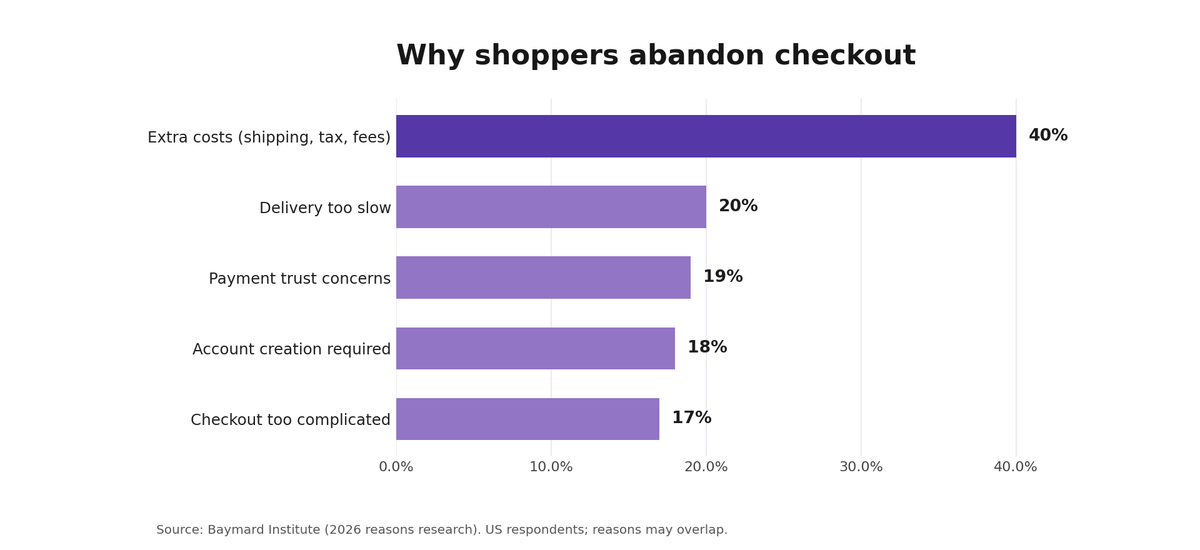
The operational lesson is clear: reminders work best when they address genuine friction. A WhatsApp message cannot repair a broken checkout, reveal a missing payment option, or make an unavailable item appear in stock.
Abandoned product browse, cart and checkout are not the same
- Abandoned browse: a visitor viewed a product but did not add it to the cart.
- Abandoned cart: an item was added, but checkout was not started.
- Abandoned checkout: the customer began checkout but did not place an order.
Shopify Messaging supports distinct automation templates for abandoned product browsing, carts and checkouts, with channels including email, SMS and WhatsApp where eligible. Shopify's older abandoned-checkout help documentation uses a threshold of more than 10 minutes after the customer has entered contact information. Exact record availability and triggers can differ between legacy and new automation experiences.
What Shopify can already do without a third-party AI agent
Shopify's native Messaging app supports WhatsApp abandonment automations, subject to channel setup and eligibility. Meta must approve relevant WhatsApp templates, and the store generally needs the customer's WhatsApp marketing subscription for automated marketing messages. Merchants do not have to buy an AI voice agent simply to send a basic recovery reminder.
On 28 October 2026, Shopify announced native WhatsApp marketing automations for abandoned browsing, carts and checkouts. Confirm the merchant's eligibility and consent configuration before choosing between native reminders and an additional conversational AI workflow.
A connected AI system becomes relevant when the merchant wants a two-way exchange: asking what stopped the order, checking accurate product or shipping information, responding in Urdu or English, directing customers to a verified checkout, or transferring an exception to staff. Those are configured integrations and workflows—not automatic outcomes of installing a WhatsApp template.
A consent-first recovery workflow
Step 1: Detect the right event
Read the relevant Shopify abandonment event, confirm the checkout is still incomplete, and exclude duplicate attempts, already-purchased orders, high-risk cases and contacts who have opted out.
Step 2: Check eligibility before outreach
Verify the customer's channel-specific marketing consent, destination, message category and applicable Meta template rules. Do not treat a customer's phone number entered for delivery as automatic permission for promotional outreach.
Step 3: Send a useful WhatsApp message
Use an approved template that identifies the store, references the abandoned shopping journey without revealing unnecessary personal information and offers a direct route to assistance or a valid checkout link. Avoid exaggerated urgency or invented stock shortages.
Step 4: Continue the conversation safely
If the customer replies, an authorized assistant can answer approved product, delivery and return-policy questions during the available customer-service window, or route the enquiry to a person. Ensure the order amount, discount and stock are checked against current records.
Step 5: Consider a call only when appropriate
An AI-assisted outbound call is a separate, more intrusive channel. Use it only when there is appropriate calling consent, the message is expected, the business can honor opt-outs, and the calling workflow is legally and operationally appropriate. A high-value order alone is not permission to call.
Step 6: Stop promptly and measure
End the sequence when the customer purchases, unsubscribes, is already being helped, or reaches the contact limit. Attribute recovered orders cautiously; a purchase after a reminder does not by itself prove the reminder caused the sale.
How to estimate whether recovery is profitable
Use contribution margin rather than headline revenue. A simple planning equation is: incremental recovered orders multiplied by contribution margin per order, minus Meta delivery fees, AI charges, call costs, discounts and staff effort. Do not confuse an observed recovery rate with incremental uplift: a control group or controlled holdout is needed to estimate how many orders would have happened anyway.
For an illustrative calculation only, if a campaign produces 12 genuinely incremental orders with PKR 800 contribution margin each and costs PKR 3,000 in total, its net contribution is (12 × 800) − 3,000 = PKR 6,600. These are hypothetical inputs, not Callvio or industry results.
Five mistakes that reduce recovery quality
- Sending messages without recorded marketing permission.
- Using a generic reminder when the actual obstacle is shipping cost or an unavailable payment method.
- Calling customers who consented to marketing messages but not calls.
- Using stale catalog, discount, stock or shipping information.
- Claiming that all orders completed after a reminder were caused by that reminder.
Where Callvio fits in a Shopify workflow
For merchants that need conversational follow-up, Callvio can be configured around connected Shopify data, approved WhatsApp messaging and permitted outbound voice workflows. Implementation should verify data access, message templates, consent records, human handoff, retry limits and billing before the first campaign. Recovery claims should be based on merchant-specific evidence rather than generic industry averages.
For Pakistan-specific COD verification and store setup, read Shopify WhatsApp automation in Pakistan. For the broader buying journey, see conversational commerce for Pakistani retailers.
When a cart reminder is a bad idea
Exclude customers who have already purchased, opted out, raised a complaint or lack the required marketing consent. Deduplicate trigger events across cart and checkout recovery so the same customer does not receive repeated reminders. Evaluate recovered contribution margin after messaging and support costs, not a gross 'recovered sales' number that includes purchases which would have happened anyway.
For COD verification and support, read Shopify WhatsApp automation in Pakistan. For the cost side, use WhatsApp AI chatbot pricing and Meta fees.
What is a practical abandoned checkout recovery sequence for Shopify?
A reference sequence is: detect an eligible abandoned checkout; wait an agreed period; check whether the shopper has since purchased or opted out; send an approved reminder with the relevant checkout link; and respond to genuine questions about delivery, payment or availability. Stop the sequence on purchase, opt-out, expiry or an ineligible contact state.
For higher-value checkouts, test a separately authorized callback only when it adds value, such as resolving a payment or delivery question the customer raised. Measure incremental contribution margin against a comparable group receiving the standard reminder. Do not treat all later purchases as recovered sales, and do not assume consent to WhatsApp is consent to a telephone marketing call.
Related guide: outcome-based performance and ROI measurement
Frequently asked questions
Can Shopify send abandoned-cart WhatsApp messages by itself?
Yes, Shopify Messaging documents WhatsApp automation options for eligible stores. A third-party AI platform is not necessary for basic reminders.
Can I WhatsApp every customer who abandons checkout?
No. WhatsApp marketing requires appropriate opt-in and approved templates, and the required contact data may not exist for every abandonment.
Should I use WhatsApp or an AI call?
Start with a consented, low-friction message. Reserve calls for circumstances where permission and customer expectation make calling appropriate; measure whether the extra cost adds incremental conversions.
Sources
Baymard Institute — cart abandonment rate and 2026 reasons
Shopify Help Center — recovering site visitors through messaging automations
Shopify Changelog — WhatsApp marketing automations, 28 October 2026
Shopify Help Center — WhatsApp marketing eligibility and consent
WhatsApp Business Messaging Policy — opt-in and template rules
Shopify Help Center — abandoned checkout recovery and measurement